Following on from my last post, I decided to take my experiments with cyanotype and alcohol ink a little further because in neither case I had got exactly what I was looking for.
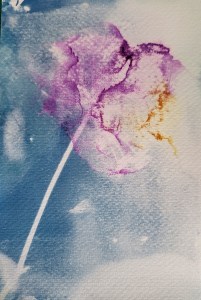
In the second print in my last post, which was on watercolour paper, whilst I quite liked the painterly effect, the whole thing was under exposed, either that or the PVA size, which I had added to allow me to manipulate the ink, had stopped the cyanotype chemicals from being absorbed into the paper. Either way, I needed to work out what was happening. So, I coated the paper and exposed it again, carefully placing the same seedhead onto the wet paper.
I didn’t add any of the additional extras that I would normally add to wet cyanotypes, such as vinegar, turmeric or soap suds, one thing at a time!
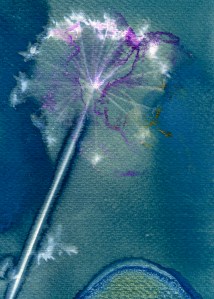
The resulting print is certainly more like a cyanotype than the previous attempt. I do need to think more carefully about what effect I want from the ink, so more practice needed there. I also need to take my time and do some test prints to get the exposure right. This one, being wet , was exposed for several hours, then left overnight before I removed the plant material and washed the print. In the end, it was washed for quite a long time to get as much chemical out as possible as the print was quite dark.
I mentioned in my last post that Yupo paper is quite expensive. Too expensive to experiment with really, but there doesn’t seem to be a right or wrong side and as the chemicals don’t soak into the paper, I decided to try my second experiment with this, on the reverse of the first print.
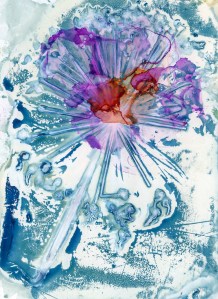
First time round, I felt that the consistency of the gelatine was too thick, so after a few more YouTube searches, I diluted it further. I’m still not sure I have the ratio of gelatine to cyanotype chemicals correct, if anything, I may have diluted the gelatine too far this time, as the solution did not adhere to the paper was well as I’d hoped. Again, this was exposed whilst the paper was still wet and again, whilst not what I had expected, it does have potential and I do quite like the painterly effect.

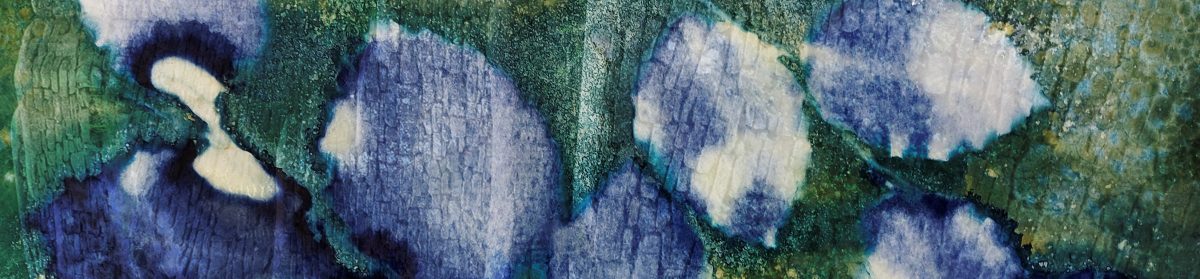
My final print from this session was a wet cyanolumen on expired Kentmere Bromide Stipple darkroom paper. Again I added a little of the gelatine mix to the coating solution as last time I used this paper, I found that the cyanotype chemicals did not adhere to the paper very well. The only problem I had this time was that the plant material stuck to the paper so I had to soak it the whole thing in order to remove it. The plant material here is bluebells and ferns pressed last year and then forgotten about. This print was fixed in Ilford Rapid Fixer. Do I need to do that with a cyanolumen? I know I need to fix lumen prints but not sure if I need to fix cyanolumens too, need to check that one out!
 Anne Bryson Photography